
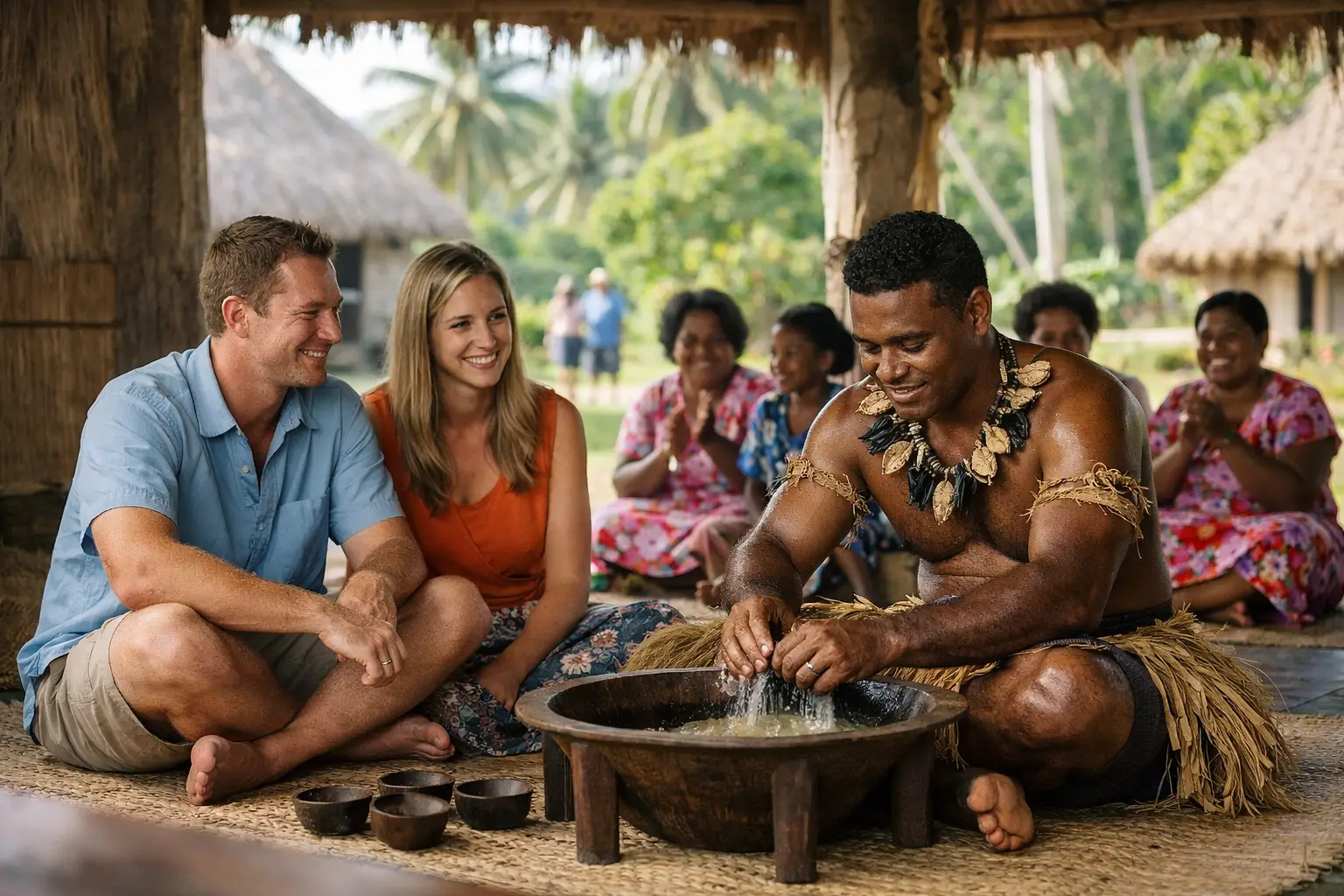
A cruise call in Fiji can feel brief: the ship arrives, the harbor comes alive, and there is suddenly a whole island beyond the pier. A fiji village cultural tour offers a meaningful way to use that time, moving beyond the coastline to meet the people, customs, and everyday values that shape Fijian life.
The best visits are not about collecting photos of a distant culture. They are hosted encounters, guided with care and shaped by the village welcoming you that day. You may hear a choir fill a church, sit for a kava ceremony, watch traditional crafts being made, or share a meal prepared in an earth oven. Just as valuable are the conversations in between: the stories behind a family home, the role of the village chief, and the sense of community that visitors often notice immediately.
Why a Fiji Village Cultural Tour Feels Different
Fiji is made up of more than 300 islands and many distinct communities, so no two village experiences are exactly alike. Customs, performance styles, food, language, and the rhythm of the day can vary by region. A respectful tour does not promise a single, simplified version of Fiji. Instead, it creates space for guests to understand the traditions of one community while recognizing the depth and diversity of the country as a whole.
For cruise guests, this matters especially. Limited time ashore can make it tempting to choose the closest activity or the most crowded attraction. A well-organized village visit provides a stronger sense of place, with transport, timing, local guidance, and return-to-ship planning managed around the vessel’s schedule. It replaces uncertainty with a day that is both welcoming and well coordinated.
Cultural visits also offer a different kind of luxury. There may be no need for elaborate scenery when a host shares the meaning of a woven mat, a village elder explains a ceremony, or children greet visitors with a song. These moments are personal, grounded, and difficult to recreate elsewhere.
What You May Experience During a Village Visit
A typical visit often begins with a formal welcome. In Fiji, greetings matter. Guests may be received by community members, introduced to local hosts, and welcomed into a communal space such as a village hall or meeting area. Depending on the village and itinerary, this may include a traditional kava ceremony.
Kava is a ceremonial drink made from the root of the yaqona plant. It has a mild, earthy taste and is traditionally served from a communal bowl. Your guide or host will explain how to receive it respectfully, including the customary clap before and after drinking. Participation is generally encouraged but should never feel forced. Guests with dietary, medical, or personal concerns can simply ask their guide for advice.
Music and dance may also form part of the experience. Fijian performances are not merely entertainment between stops. Songs can preserve history, welcome visitors, mark celebrations, and express connections among families and villages. Listening to the introduction before a performance adds context that makes the experience far more memorable.
Food is another highlight. You may be offered tropical fruit, cassava, taro, fresh fish, coconut-based dishes, or food prepared in a lovo, Fiji’s traditional underground oven. Menus depend on the hosts, season, and program. If you have allergies or follow a vegetarian, vegan, gluten-free, or other special diet, communicate this before your tour. Advance planning gives the operator and hosts the best opportunity to accommodate you thoughtfully.
Some tours include demonstrations of mat weaving, coconut preparation, pottery, or other local skills. Others pair the village visit with a school, market, garden, waterfall, or scenic inland drive. The right combination depends on how long your ship is in port, the travel distance involved, and whether you prefer a more intimate cultural focus or a broader view of Fiji’s landscapes.
Etiquette That Shows Respect
Fijians are widely known for their warmth, but cultural hospitality works best when visitors arrive ready to be considerate. Dress modestly for a village visit. Clothing that covers shoulders and knees is a sensible choice, and a sulu may be provided or recommended in some settings. Swimwear, very short shorts, and revealing tops are best reserved for the beach or resort.
Always follow your guide’s direction before taking photographs or videos. In many cases, hosts are happy for guests to capture special moments, but permission should not be assumed, particularly around homes, places of worship, children, or ceremonial activities. A quick question is a simple sign of courtesy.
Removing hats or sunglasses during a formal welcome may be appropriate, and it is polite to keep voices low in ceremonial spaces. If you are invited into a home or hall, follow the lead of your hosts on footwear and seating. Avoid stepping over people seated on the floor, and do not rush through a moment that has been offered with genuine care.
Small gestures make a difference. Learn a few words such as “bula” for hello and “vinaka” for thank you. Accepting an invitation with a smile, listening without interrupting, and asking thoughtful questions signal that you are there to connect rather than simply observe.
Choosing the Right Experience for Your Port Day
The most rewarding tour is not necessarily the longest one. If your ship has a short port call, choose an experience with realistic driving times and clear return arrangements. Fiji’s roads can be scenic and enjoyable, but travel times may be longer than a map suggests, especially when routes head inland or pass through smaller communities.
Guests traveling with young children, older relatives, or limited mobility should ask specific questions before booking. Is there a walk on uneven ground? Are there stairs? Is air-conditioned transport available? Are restrooms accessible during the day? A good operator will provide clear answers and recommend an itinerary that suits the group rather than asking guests to adapt to an unsuitable program.
It is also worth considering the pace you want. A village-focused excursion may be ideal for travelers who value conversation, ceremony, and local stories. A combined cultural and nature tour may suit those who want time in a village alongside a river, garden, lookout, or waterfall. Private touring can offer more flexibility for families, VIP guests, and multigenerational groups, particularly when timing, mobility, or special interests require a tailored approach.
For cruise lines and travel advisors, the same principles apply at scale. Cultural experiences need more than an appealing itinerary. They require reliable coaches, trained guides, confirmed community arrangements, guest communication, and contingency planning for ship schedules and weather. Local destination-management experience is what turns a promising excursion into one that operates confidently for hundreds of passengers.
Rosie Fiji Cruises coordinates shore experiences with the transport, guides, timing, and local knowledge needed to help visitors experience Fiji with confidence while respecting the communities that welcome them.
The Value of Going With a Local Guide
A knowledgeable guide does more than point out landmarks from the coach. They explain what guests are seeing, prepare them for local protocols, and help bridge the natural gaps between visitors and hosts. They may explain why a village green is important, how communal responsibilities work, or what a particular word, song, or gesture means.
That context matters because culture is living, not frozen in time. Villages are homes to families balancing tradition with work, school, church, agriculture, technology, and modern life. A good guide helps guests appreciate both the heritage and the present-day reality, without turning people’s daily lives into a spectacle.
Guides also provide practical reassurance. They know how to manage arrival times, weather changes, guest needs, and respectful communication. For passengers who have traveled a long way to reach Fiji and have only one day ashore, that care allows the experience to feel relaxed rather than rushed.
Leave With More Than a Souvenir
A village visit may include opportunities to purchase handicrafts, but the most lasting takeaway is often a better understanding of Fiji’s communal spirit. Family ties, respect for elders, faith, land, and shared responsibility remain central to many communities. Visitors often leave recalling not only a dance or a meal, but the ease with which they were welcomed into a place that was not built solely for tourism.
Come prepared to listen, dress respectfully, and allow the day to unfold at a local pace. When that openness meets thoughtful planning, a Fiji village cultural tour becomes one of the few shore experiences that stays with you long after the ship has left the islands behind.