
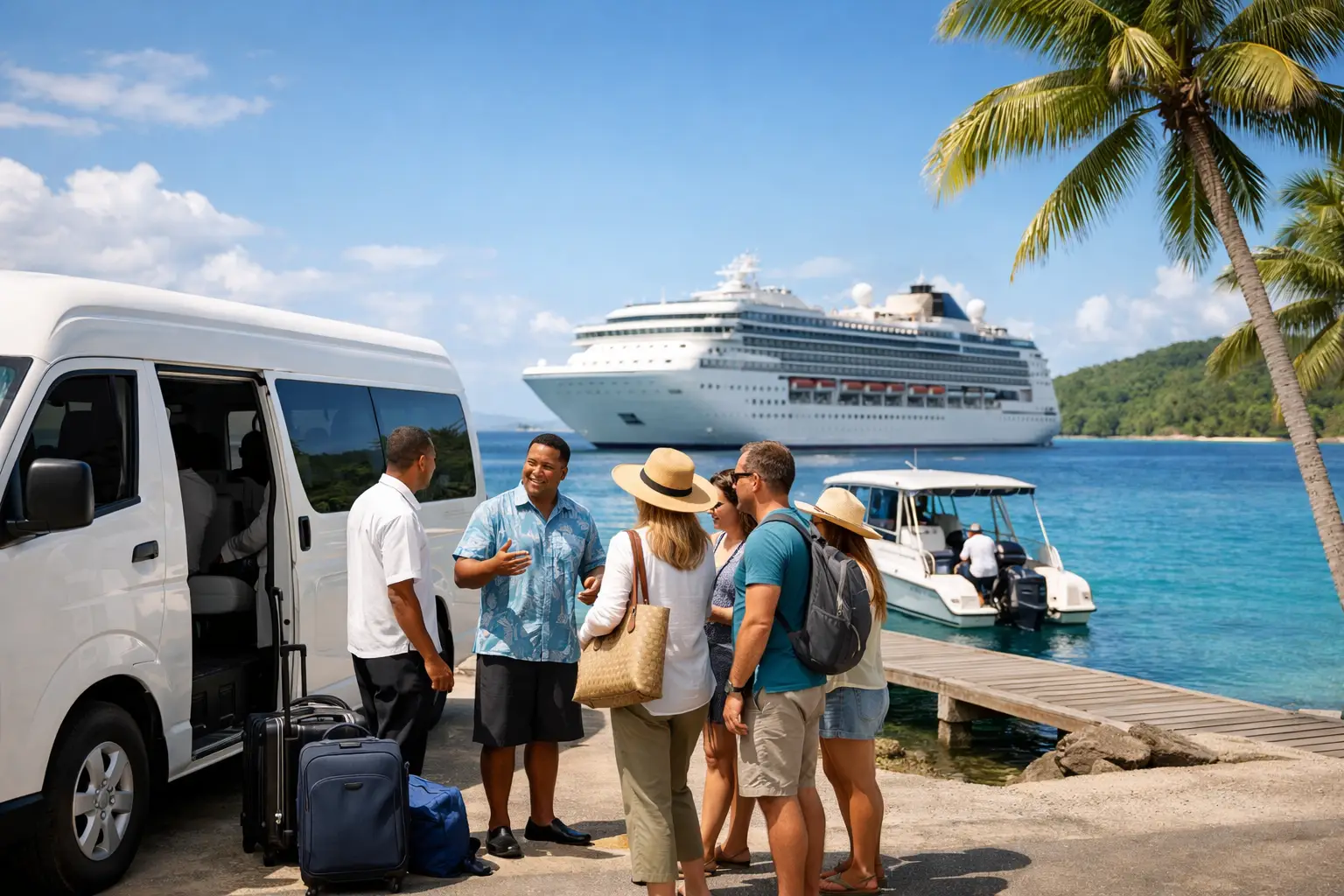
A ship may be in port for only a few hours, but moving a family reunion, incentive group, wedding party, or full shore-excursion program requires careful work long before guests step ashore. To arrange group cruise transport Fiji cruise calls require more than reserving vehicles. It means matching group size, ship timings, port access, luggage needs, mobility considerations, and the experience guests hope to have between arrival and all-aboard time.
For cruise lines, travel advisors, and group leaders, the right local transport plan turns limited port time into a relaxed, well-paced Fiji experience. For guests, it creates the confidence that someone is waiting, the route is understood, and the return to the vessel is managed with care.
Start With the Cruise Call, Not the Vehicle
The first question is not whether the group needs a coach, minibus, or private car. Start with the vessel itinerary and the purpose of each transfer. A short call in Suva calls for a different plan than an overnight stay, a pre-cruise arrival in Nadi, or a multi-day fly-cruise program that combines resort stays with island travel.
Confirm the ship's scheduled arrival, passenger-clearance timing, gangway location, all-aboard deadline, and any port-specific procedures. Build in time for guests to disembark, gather at the meeting point, and return before the final boarding window. Fiji roads are scenic and varied, but journey times can be affected by weather, local traffic, roadworks, and village or school activity. A good itinerary protects the ship departure time rather than treating it as a target to reach at the last minute.
For larger movements, organizers should also establish whether guests are traveling as one group or in staggered departures. A single 300-person group may need several coordinated coaches with dedicated guides and clear vehicle assignments. A smaller VIP party may prefer a private arrival service and flexible touring vehicle. The most suitable transport is the one that supports the guest experience while keeping operations clear and accountable.
Arrange Group Cruise Transport Fiji Visitors Can Trust
Reliable group transport begins with accurate information. Share final passenger numbers as early as possible, then update the transport partner when cabins, flights, dietary requirements, or mobility needs change. The best operations plans are detailed enough to prevent confusion but flexible enough to accommodate a late disembarkation or a guest who needs additional assistance.
A complete brief should cover the group leader's contact information, ship name and call date, port, expected disembarkation window, group size, luggage volume, ages of children, accessibility needs, and planned destinations. It should also identify whether the group includes guests arriving independently before embarkation or continuing their Fiji vacation after the cruise. Those stages often require airport transfers, hotel transport, or private touring that should be coordinated with the main program.
It also helps to identify priorities early. Some groups want the shortest possible transfer to a cultural performance or waterfront venue. Others value a gentle scenic drive, time for shopping, or a stop at a local market. Multigenerational groups may need easier walking routes and more frequent comfort stops, while corporate incentive guests may require a polished welcome, branded vehicles, hosted check-in, or an event transfer schedule.
Choose Capacity With Comfort in Mind
Filling every seat can look efficient on paper, but it is not always the most comfortable choice. Guests may carry day bags, mobility aids, strollers, cameras, or shopping purchases. A group traveling with checked luggage from the airport to a cruise terminal needs a different vehicle configuration from shore guests carrying only a hat and sunscreen.
Coach transport is often effective for high-volume ship operations and large event groups. Smaller vehicles can be better for families, private groups, special-interest touring, and guests who want more flexibility. For high-end programs, private VIP transport can add privacy and ease, particularly when arrivals, dining reservations, resort check-ins, or short transfer windows are involved.
The key is to plan for the entire movement: loading, luggage handling, guide access, passenger headcounts, and drop-off procedures. Capacity is not simply a seat count.
Keep the Journey Part of the Fiji Experience
Transport is also the first and last impression of a destination. The drive from port to an inland village, a coastal resort, or a city attraction is an opportunity to introduce Fiji with context and warmth. A trained local guide can explain the landscapes, everyday life, customs, and history guests are seeing rather than leaving them to watch the view through a window.
This matters especially for cruise visitors who may have only one day to understand the destination. The most meaningful shore programs balance travel time with time on the ground. A beautiful destination that requires too much driving can leave guests rushed. Conversely, a short transfer alone does not create a memorable Fiji experience unless it leads to something worth sharing.
Groups often benefit from pairing transport with a well-matched activity: a guided cultural visit, a city and market orientation, a river or island experience, an inland 4WD outing, or an evening of traditional Fijian entertainment. The choice depends on port location, call length, weather, group interests, and guests' confidence with activity levels. Good local planning makes these decisions practical rather than promotional.
Plan for Weather, Mobility, and Real-World Changes
Fiji's tropical conditions are part of its appeal, but they deserve respect in group planning. Rain can arrive quickly, sea conditions can affect marine connections, and warm temperatures can feel more demanding for guests unused to the climate. Build shade, water, restrooms, and appropriate waiting areas into the day, particularly for older travelers and families with young children.
Accessibility should be discussed directly, not assumed. Some guests may manage a coach easily but find uneven paths, boat boarding, or long walks difficult. Others may need a vehicle with easier access, room for a folding wheelchair, or a program with minimal stairs. When these needs are known in advance, the itinerary can be adapted with dignity and without disrupting the group.
Contingency planning is equally important for cruise operations. If a ship arrives late, an excursion runs behind, or a weather change affects an outdoor component, guests need calm direction and practical alternatives. This is where a locally established destination-management partner is particularly valuable. Transport dispatch, guides, port teams, activity providers, and guest support must be able to communicate quickly and work from the same operational plan.
Give Guests Clear Instructions Before They Disembark
Even an excellent transport plan can falter if guests do not know where to go. Provide simple pre-arrival instructions that include the meeting location, departure time, expected duration, what to wear, what to bring, and the name or identifier of the host team. For large groups, coach numbers, color-coded tags, or subgroup assignments reduce crowding and repeated questions at the port gate.
Group leaders should carry a final itinerary, transport contacts, guest list, and a clear process for headcounts. Guests should understand that all-aboard time is non-negotiable and that the group will depart the venue at the scheduled time. This is not about making the day feel rigid. It is what allows everyone to enjoy Fiji without watching the clock.
For passengers extending their stay, provide equally clear handoffs. A transfer from ship to hotel, airport, resort, or domestic flight should include luggage arrangements, pickup details, and realistic travel times. Rosie Fiji Cruises can coordinate these connected services as part of a broader Fiji program, helping groups move from ship to shore and onward without having to manage separate suppliers.
The Value of One Coordinated Local Team
A group transport plan has many moving parts, from permits and port access to vehicle timing, guides, refreshments, luggage, and guest care. Using one experienced local team does not remove every variable, but it gives the group one point of accountability when plans need adjusting.
That is particularly useful for cruise lines handling high passenger volumes, advisors arranging a hosted sailing, and organizers bringing together guests who have different expectations and abilities. Local knowledge helps shape realistic timing; trained hosts make guests feel welcome; and 24/7 operational support offers reassurance when a detail changes outside regular office hours.
The most successful Fiji cruise day rarely feels like a transport operation. Guests remember the smiling welcome, the stories shared on the road, the warmth of a village greeting, the coastline beyond the window, and the feeling of returning to their ship on time. Plan the logistics carefully enough, and Fiji has room to do the rest.